Federal budget / German climate finance / Pledges & Commitments
2025 and 2026 aid cuts likely to push Germany’s climate finance pledge out of reach
Germany’s federal budget for 2025 has been approved, while the budget for 2026 is still being negotiated in the Bundestag. The federal government is planning significant aid cuts for both years. This is likely to push Germany’s climate finance pledge out of reach. A billion euros might be missing for 2026.
At the 2021 G7 summit, then-Chancellor Angela Merkel (CDU) pledged to increase budgetary resources for financial support to low-income countries for climate action in tackling the climate crisis to at least six billion euros per year by 2025 at the latest. After Olaf Scholz (SPD) took office as head of government, he reaffirmed the commitment at the 2022 G7 summit. The commitment received a lot of international attention and recognition at the time, especially among low-income countries, which once again saw Germany as a reliable partner in the fight against climate change.
Now, the German government reports that it has fulfilled its commitment last year, reaching around €6.1 billion in budget resources for climate finance in 2024 (including grant equivalents of low-interest loans).1 The government has thus claims to have fulfilled its pledge – for 2024, at least, even though the level achieved was still well below the previous record year of 2022. At that time, the German government reached a total of around €6.4 billion.
Aid cuts 2025 and 2026: Germany likely to break its climate finance promise
The joy could be short-lived. For the current year, the Bundestag, with the votes of the governing coalition, has decided on significant cuts to the budget of the Federal Ministry for Economic Cooperation and Development (BMZ) in the 2025 federal budget. The draft submitted to the Bundestag already included cuts in the BMZ’s total budget of a billion euros compared to 2024 and around 1.7 billion euros compared to 2023. The BMZ budget is set to fall further in 2026.
| Fig. 1: Aid cuts likely to push Germany’s climate finance pledge out of reach |
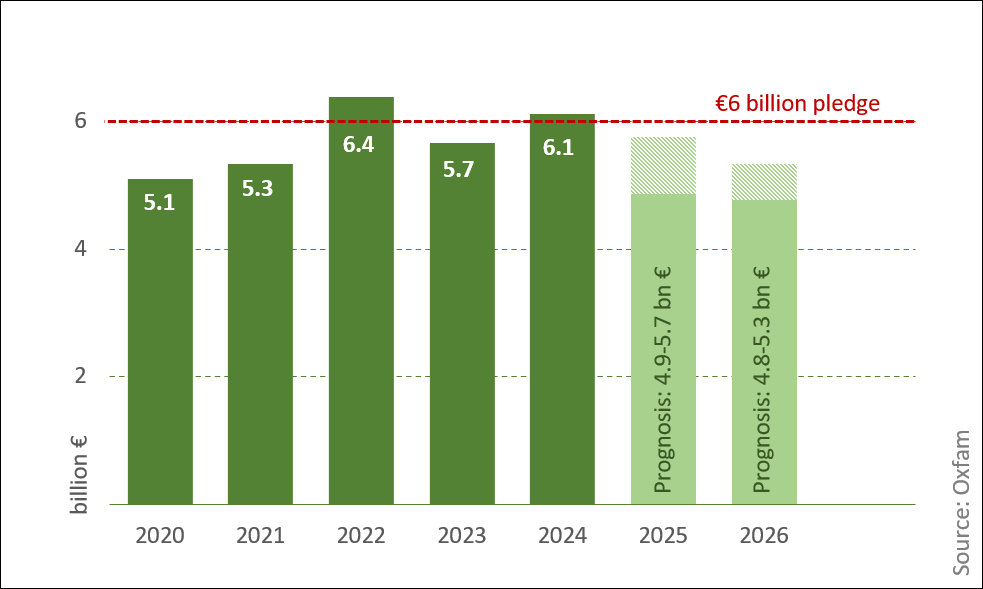
The figure shows 2020-2024 federal budget resources for climate finance as reported by the German government under the EU’s Governance Regulation, as well as our projection for 2025-2026. According to the German government’s commitment, climate finance budget resources should reach at least six billion euros per year by 2025 at the latest. Based on our assessment of the approved 2025 and the proposed 2026 federal budget, the government is pushing Germany’s climate finance pledge out of reach.
With these cuts, the government coalition partners CDU and SPD is dealing German development co-operation a severe setback that will also directly impact German climate finance that it is largely funded from the BMZ budget.
It is possible to estimate what this could mean for Germany’s six-billion promise. For some budget lines, their expected contribution to climate finance can be directly derived from the budget plan itself, for example for upcoming payments into various multilateral climate funds such as the Green Climate Fund (GCF) or the Fund for Responding to Loss and Damage (FRLD). For some other (smaller) items, empirical values are available.
However, the majority of climate finance comes from a number of budget lines that serve general development co-operation. Here, the potential contributions to climate finance can be extrapolated based on the assumption that the share of climate finance in 2025 in the total volume of the relevant budget lines will correspond to that of previous years. For such an extrapolation, the commitment appropriations (CA) of the relevant budget lines are particularly important, as it is largely these (and much less the foreseen expenditures in a budget line) that define the total volume of the typically multi-year programming commitments Germany makes in bilateral co-operation.2 These CAs have been cut back considerably for many of the BMZ budget lines relevant to climate finance, both for 2025 and 2026: For example, the CA for bilateral technical cooperation for 2025 amounts to only around 1.5 billion euros, compared to around 1.9 billion euros in 2024, and the CA for bilateral financial cooperation (FC) amounts to only around 1.4 billion euros (2024: around 1.8 billion euros).
As a result of the extrapolation, we estimate that climate finance from budgetary resources (including grant equivalents of concessional loans) will amount to 4.9-5.7 billion euros in 2025 and 4.8-5.2 billion euros in 2026, missing the promised level of at least six billion euros a year is in both years. We are of course aware that our estimate is not a prediction, and any attempt to project into the future is to be treated with care. Yet we believe our estimate is robust and based on reasonable assumptions.
Ahead of COP30: Germany damaging the carefully crafted balance of trust?
Our estimate suggests that enacted and planned aid cuts will push Germany’s climate finance pledge out of reach, i.e. that the German government will likely be unable to reach at least six billion euros per year in 2025 and 2026. This would be a a fatal signal to the international community and a blow to the carefully crafted balance of trust between developing and developed countries that is critical for progress in global climate policy, especially for the poorest and most vulnerable countries. Travelling to the next UN Climate Change Conference COP30 with such prospects would seriously call into question Germany’s credibility and reliability in the UNFCCC process.
It will be difficult to improve the situation for the current year, as the 2025 budget has already been approved. This makes it all the more important for the Bundestag to take countermeasures in the current budgetary process for 2026 and not simply rubber-stamp the planned cuts in development co-operation. In order to fulfil Germany’s climate finance promises, albeit belatedly, funding for 2026 would have to be significantly increased. There are plenty of options for counter-financing, including the gradual abolition of environmentally harmful subsidies (which in Germany tend to benefit people with higher incomes) or tax reforms to make the rich and super-rich take greater responsibility for public welfare – for which there is a clear majority in Germany.
It is to be hoped that in the current budgetary process, members of parliament, especially those of the government coalition, realise how much successfully tackling the climate crisis in the Global South ultimately also serves Germany’s interests. Climate finance enables important programmes in low-income countries, including to transform developing countries’ energy supply systems, but also to protect harvests or water resources from future weather extremes and adapt people’s livelihoods to the changing climate, allowing people to thrive and escape poverty, ultimately also contributing to local, regional and global stability. This makes climate financing an investment in a liveable future for all, both in Germany and abroad. Germany must live up to its international responsibility.
Jan Kowalzig, Oxfam
Editorial note (2026): In an earlier version of this article, the forecast was somewhat lower than shown now. Based on new data by the government on climate finance disaggregated by budget titles, our forecast has now changed. A significant gap to the 6-billion pledge remains.
1 A further 4.6 billion euros was provided in the form of funds mobilised by KfW and DEG on the capital market for the creation of public loans and other instruments, as well as around 1.1 billion euros in private investments mobilised by the Germany. Both items are part of climate finance as it is commonly understood internationally and reported under the Paris Agreement; however, Germany’s 6-billion promise refers exclusively to budgetary funds and grant equivalents.
2 Much of the planned expenditure in the budget lines for bilateral development co-operation is used to finance such commitments previous years during the implementation of financed measures. Only a small proportion of the planned expenditure is used to finance new (multi-year) commitments, namely when implementation begins in the year of the commitment.