German climate finance / Federal budget / Pledges & Commitments
2027 federal budget: Germany must honor its climate finance commitments
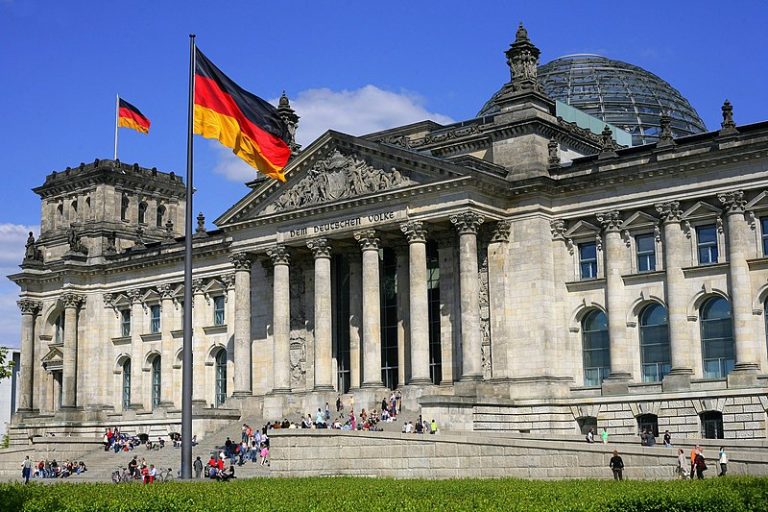
Negotiations on the German federal budget 2027: The German parliament (Bundestag) can still avert the impending breach of promise regarding climate financing. Photo: Cezary Piwowarski, unter der CC BY-SA 3.0-Lizenz.
The planned cuts to development cooperation also threaten Germany’s commitment to climate finance. What are the implications of this for the negotiations on the 2027 federal budget?
Financial support for low-income countries is a cornerstone of global cooperation in implementing the Paris Agreement, which legally obligates industrialized countries to provide such funding. Climate finance supports the expansion of renewable energy and helps agriculture cope with droughts and floods, while enabling low-income countries to pursue development paths that are climate-friendly and resilient. Climate finance thus also serves as a tool for global stability in the face of climate change, creates new markets for green technologies, and builds trusting international partnerships during geopolitically challenging times. It therefore also serves Germany’s economic, foreign, and security policy interests.
In 2021, the German government pledged to increase budget funds for climate finance to at least six billion euros by 2025 at the latest. The commitment was fulfilled for the first time in 2022 and again in 2024. No data is available yet for 2025 and 2026. As a result of the planned cuts in the 2027 federal budget, the German government risks not being able to keep its commitment to climate finance in 2027. The shortfall could amount to one billion euros or more.
Cuts target Section 23 in particular
The budget of the Federal Ministry for Economic Cooperation and Development (Section 23) is particularly affected by the cuts, especially the line items for bilateral technical and financial cooperation, whose commitment appropriations are projected to be nearly 700 million euros lower overall compared to 2024. In the line items dedicated to promoting civil society (political foundations, churches, etc.), commitment appropriations are about 200 million euros lower than in 2024 as well. Cuts are also planned in the line item for crisis management and reconstruction. Climate finance is provided through all these line items – presumably significantly less in 2027 than in 2024.
The cuts in contributions to multilateral climate funds – whose funding volumes are to be tripled by 2030 according to a UN climate conference (COP29) decision that was supported by the German government – are also cause for concern. The next replenishment round for the Green Climate Fund is scheduled for 2027. In 2023, Germany had pledged two billion euros, but by 2027 this figure is expected to drop to 1.65 billion euros. For the Least Developed Countries Fund (LDCF), which is of great importance for the most vulnerable countries, only 10 million euros are to be pledged in 2027 – even though the LDCF is already unable to approve any further funding programs due to a lack of financial resources.
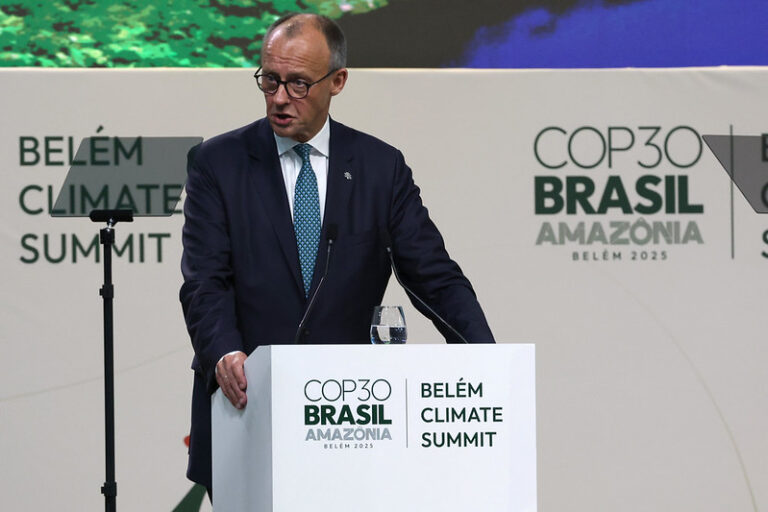
“You can rely on Germany,” said Chancellor Friedrich Merz regarding climate finance in his speech at COP30 in Belém in late 2025. These are encouraging words, but they stand in stark contrast to the cuts in development cooperation planned for 2027. Photo: Isabel B./COP30
The German government’s plans for the Fund for Responding to Loss and Damage (FRLD), a relatively new fund intended to support low-income countries in coping with unavoidable losses and damage (L&D), must be viewed with concern. Following the fund’s start-up phase, its first formal replenishment is scheduled to take place starting in 2027. The German government has apparently earmarked only 150 million euros for this purpose. Given the climate change-related costs of several hundred billion US dollars annually that low-income countries face, this reluctance is unjustifiable. Even in the current start-up phase of the fund, project applications already total 2.8 billion euros, many times the initial ad-hoc contributions from industrialized countries to the fund (including the 92 million euros pledged so far from Germany).
Cuts to climate finance are also being made elsewhere: In the Climate and Transformation Fund (KTF, Section 60), the commitment appropriation for the International Climate Initiative (IKI) is decreasing by approximately 200 million euros compared to 2024. In the past, the IKI has been an important tool for forming strategic alliances and implementing specific aspects of the Paris Agreement, such as supporting countries in developing their national climate action plans (Nationally Determined Contributions, NDC). Given the stalled negotiations on implementing the Paris Agreement, cutting funding for this flagship project of the German government seems short-sighted.
The KTF also includes the budgetary implementation of the German government’s commitment to the Tropical Forest Forever Facility (TFFF). After some hesitation, Chancellor Merz had pledged one billion euros to the facility in 2025. The pledged funds are now to be disbursed over a period of ten years as a contribution to the TFFF’s capital stock. Lately, concerns have been raised again within the conservative CDU/CSU regarding the financial viability of the TFFF. It is to be hoped that these concerns can still be resolved. For Germany to be going back on its commitment would be more than just an embarrassing incident on the international stage.
Priorities for the budget negotiations
If the German government is to keep its word regarding the six-billion-euro pledge, so as not to embarrass itself internationally and to avoid recklessly squandering the hard-won trust of low-income countries, the cuts must be urgently reversed. From Oxfam’s perspective, the following priorities for climate finance emerge for the 2027 federal budget:
- If the German government is to keep its word, at least one billion euros in additional funding for climate finance would be needed, primarily in the BMZ budget (Section 23), for example through a corresponding increase in the commitment appropriations[1] for relevant line items such as those for general bilateral, financial, and technical cooperation in Section 23.
- Additional funding would also be desirable for the successful and strategically well-positioned International Climate Initiative (IKI) within the Climate and Transformation Fund (KTF, Section 60), particularly through an increase in the commitment appropriation for the IKI line item in the KTF under Section 60.
- The planned pledges to the GCF and the LDCF should be significantly increased, primarily by raising the commitment appropriation for the line item covering multilateral environmental and climate funds in Section 23.
- If it turns out that the pledge planned for 2027 for the Fund for Responding to Loss and Damage (FRLD) is indeed intended for its first formal replenishment, and not an additional contribution to the fund’s start-up phase, the commitment should be significantly more ambitious (by means of a further increase in the commitment appropriation under the line item for multilateral environmental and climate funds).
With Oxfam’s proposals (see here for German version), it would be possible to meet the six-billion-euro pledge for 2027. However, that would only be the first step: In contrast to the further cuts planned for subsequent years, a continued increase in funding would be necessary so that Germany can contribute its “fair share” to climate finance in the longer term, as promised in the government’s coalition agreement. The guiding principle here must be to meet the goals agreed upon at past UN climate conferences: to increase international climate finance to at least 300 billion US dollars, while simultaneously tripling both support for climate change adaptation by 2035 and the funds provided through multilateral climate funds by 2030. All these goals regarding the future of climate finance were also approved by Germany’s current federal government. At a minimum, Germany should honor its six-billion-euro pledge, at least for 2027 for now.
Jan Kowalzig, Oxfam
[1] The commitment appropriations of the individual budget line items are the key instrument for multi-year commitments commonly used in bilateral cooperation, but also for multi-year commitments to multilateral climate funds. A robust increase in climate finance must therefore come primarily from an increase in commitment appropriations. The cash reserves in any given year are largely used to gradually finance commitments from previous years.