International climate finance / NCQG / UNFCCC negotiations
Climate finance 2023-2024: real effort two thirds below reported levels
Just in time for the recent Bonn climate talks SB64, the OECD reported that climate finance provided and mobilised by developed countries in support of developing countries’ climate action had reached nearly $137 billion in 2024. Yet, as a new estimate shows, the actual financial effort by developed countries 2024 has been less than a third and possibly just a a quarter of what officially reported figures seem to suggest.
As per the recently published OECD update, developed countries have reported $136.7 billion in climate finance for 2024, up from $132.7 billion in 2023, well surpassing the $100 billion level promised per year over the 2020-2025 period. Despite the remarkably high levels of reported finance, fundamental criticisms remain, such as that most of the finance provided comes in the form of loans, the majority of which not even on concessional terms, potentially leading to exacerbating already crushing debt levels in countries; or that there is still no balance between mitigation and adaptation; or that only token amounts of provided support are channelled to address unavoidable, climate-induced losses and damages.
Actual fiscal effort support: $45 billion at best
A new Oxfam estimate now shows that the financial effort by developed countries in providing climate finance in 2023 and 2024 was significantly lower than what officially reported figures seem to suggest. As per this estimate, ‘Climate-Specific Net Assistance’ (CSNA) reached $31-43 billion in 2023, and $33-45 billion in 2024, less than a third or even just a quarter of reported amounts. For supporting adaptation, Oxfam estimates that the actual effort by developed countries in 2024 was $18 billion at best.
| Figure 1: Reported climate finance versus Climate-Specific Net Assistance, 2023-2024 |
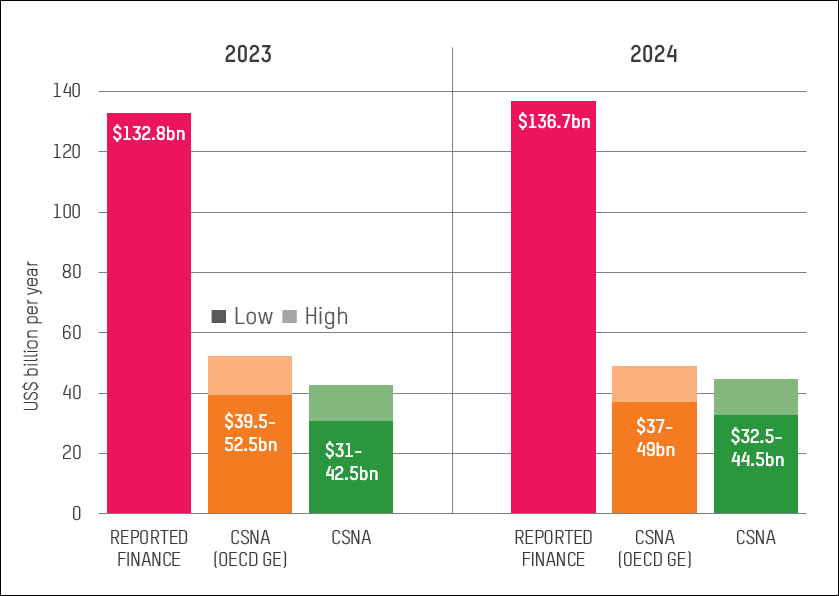
The red bars show reported climate finance as compiled by OECD. The orange and green bars show estimates of CSNA, rounded to the nearest 0.5 billion US$ and based on the OECD’s climate-related development finance datasets. The orange bars use the standard OECD method for grant equivalent accounting that uses fixed discount rates. The green bars use Oxfam’s more robust grant equivalent methodology for more accurate accounting of financial effort by contributors. Lighter shading indicates the range between low and high estimates. See Oxfam’s Methodology Note for details.
The sizeable difference between reported figures and Oxfam’s estimate is rooted in the reporting practices developed countries have secured for themselves under the Paris Agreement that lead to numbers that are masking the actual effort of provided climate finance by a significant margin. The problem arises from two key issues: Firstly, climate finance continues to be dominated by loans (which is a problem in itself, exacerbating debt levels). Developed countries report these loans at their face value, rather than by the underlying financial effort they undertake (e.g., to subsidise the interest rate, in order to offer the loan at preferential terms). Secondly, the climate relevance of reported finance is often exaggerated, so that reported volumes do not reflect the support specifically directed at climate action within wider programmes.
Oxfam’s estimate aims to address these issues. The resulting CSNA figures reflect the actual financial effort by developed countries to provide finance specifically in support of climate action and, arguably, provide a better basis for measuring progress towards developed countries’ obligations under Articles 4.3 and 4.4 of the UNFCCC and Article 9.1 of the Paris Agreement, to provide financial support to cover the cost of action in developing countries.
To calculate CSNA, Oxfam has used the OECD’ climate-related development finance datasets, discounted funds for climate-relevance (e.g., counting only a proportion of projects where either mitigation or adaptation were only a secondary objective) and then estimating the financial effort behind funds provided in the form of loans and other non-grant instruments (e.g., by calculating the grant equivalents of loans), using realistic discount rates to reflect the actual cost of borrowing for countries issuing loans. See Oxfam’s Methodology Note for details.
| Table 1: Climate-Specific Net Assistance (CSNA) by theme, 2023-2024 | ||||
| Thematic area |
2023 |
2024 |
||
| Reported Climate Finance | CSNA | Reported Climate Finance |
CSNA | |
|
Adaptation |
33.6 |
12.5-16.0 |
34.7 |
14.4-18.2 |
| Mitigation |
87.3 |
14.4-17.7 |
86.9 |
13.6-16.8 |
|
Cross-cutting |
11.9 |
4.0-8.9 |
15.1 |
4.8-9.8 |
|
Total |
132.8 |
30.8-42.6 |
136.7 |
32.7-44.7 |
|
Amounts in billion US$. ‘CSNA’ shows Oxfam’s estimate for ‘Climate-Specific Net Assistance’. Source: Reported climate finance from the recently published OECD update, Oxfam calculations, see Oxfam’s Methodology Note for details. |
||||
It is important to understand that Oxfam’s estimate does not contest the technical quality of consolidating reported climate finance figures as, for instance, undertaken by regular reports by the OECD on progress towards the $100 billion goal. But the estimate indicates, as an alternative way of measuring climate finance, that the actual financial effort by developed countries to support climate action in developing countries is vastly lower than officially reported figures seem to suggest.
NCQG: Mounting pressure on developed countries
This comes against the backdrop of recent or planned cuts in official development assistance (ODA) in many developed countries, which will further erode climate finance – and thus much-needed international trust, partnerships and co-operation. COP29 agreed, by consensus, the New Collective Quantified Goal (NCQG), including increasing the provision and mobilisation of international climate finance to developed countries to at least 300 billion US-Dollar per year by 2035. A year later, at COP30, it was also agreed that as part of the effort, annual climate finance for adaptation should be tripled by 2035. We can expect that developed countries will want to progress towards these goals by substantially expanding the use of loans (alongside mobilised private investments and convincing some countries to join the club of contributors). Given past experience, the majority of these loans will likely be on non-concessional terms. Offering mostly loans contradicts the fundamental principles of climate justice and the spirit behind the obligations for developed countries to provide assistance under the UNFCCC and the Paris Agreement. Clearly, much higher amounts of provided finance must come as public finance grants, reflecting the needs of many developing countries without driving them deeper into debt.
As part of fixing the problem, accounting standards under the Paris Agreement should be updated to ensure the true financial effort of providing such loans, and not just their face value, is properly reflected, by making reporting their grant equivalents a mandatory requirement. This would not only allow to enhance transparency on the support effort by developed countries (and thus be a better measure for progress towards existing obligations under the UNFCCC and the Paris Agreement), but also allow for much better comparison between developed countries to ensure they all provide their fair share to climate finance. This can help to put pressure on current laggards.
Jan Kowalzig, Oxfam