Multilateral funds and initiatives / NCQG / UNFCCC negotiations
Multilateral climate funds: Why public funds are needed for replenishment
While climate-related extreme weather events are on the rise worldwide – thereby further increasing funding needs that are already largely unmet – key donor countries, including Germany, are cutting their funding. It was only recently revealed that Germany failed to meet its annual climate finance commitment of six billion euros last year. The growing gap between funding needs and the funds actually available has been one of the key obstacles to implementing the targets of the Paris Agreement for years. Expectations are particularly high for the UN’s multilateral climate funds (MCF). The New Collective Quantified Goal (NCQG) agreed at COP29 envisages a tripling of their annual disbursements by 2030.
A recent policy paper by Germanwatch and the Climate Finance Advisory Service (CFAS) examines the financial reality of these funds. The conclusion: traditional contributions remain indispensable, particularly for adaptation to climate change and for addressing Loss and Damage. At the same time, in their current form, they are insufficient to meet the long-term rise in funding requirements. Without additional sources of funding, the much-vaunted ‘phase of implementation’ risks getting bogged down right from the start.
A familiar conflict with new urgency
Calls for a significant increase in climate finance are part of the long-standing struggle of those countries particularly affected by climate change. In the face of devastating extreme weather events worldwide, the call for support seems more urgent than ever. Yet in many industrialised nations, funding for international development and climate cooperation is under pressure to be cut.
Yet the multilateral UN climate funds – including the Green Climate Fund (GCF), the Adaptation Fund (AF), the Global Environment Facility (GEF), the Least Developed Countries Fund (LDCF), the Special Climate Change Fund (SCCF) and the Loss and Damage Fund (FRLD) – are key financing instruments for developing countries. While private capital can partly be mobilised for climate change mitigation projects, this is considerably more difficult when it comes to adaptation measures and addressing climate-related Loss and Damage. Here, reliable, grant-based public funding is required.
What the figures reveal: the limits of ‘tripling’
The NCQG adopted at COP29 aims to mobilise at least US$300 billion annually in climate finance for developing countries by 2035. The Baku-to-Belém Roadmap also aims to increase global climate finance flows to US$1.3 trillion annually.
Part of the NCQG decision is to at least triple annual disbursements from the UN climate funds by 2030 compared with the 2022 level (around US$1.82 billion). However, current calculations highlight the limitations of this target:
- The minimum target (strict tripling): A tripling of annual disbursements to around US$5.46 billion by 2030 would be mathematically feasible with existing resources. However, 2022 was a comparatively low baseline year. The target therefore represents a rather moderate threshold. Furthermore, this pathway neither offsets future inflation nor increases the relative share of UN funds in global climate finance.
- Sustainable growth beyond 2030: A moderate further increase in disbursements to US$8.4 billion by 2035 would be possible using existing resources, but would completely deplete the uncommitted reserves. From 2030 onwards, an additional US$2 to 3 billion per year would be required to achieve this.
- A significant share of the NCQG: If, for example, the UN climate funds were to provide five per cent of the annual US$300 billion target, the uncommitted reserves would start to shrink as early as 2027. By 2030, this would result in a funding gap of just under two billion US dollars, which would grow to a cumulative total of around 38.2 billion US dollars by 2035. This gap requires both significantly higher contributions and additional innovative sources of funding.
Traditional replenishment is reaching its limits
Climate funds are replenished predominantly through voluntary pledges from donor countries. Recent developments highlight the uncertainty associated with this: pledges for the ninth GEF replenishment, closing at around US$3.9 billion, were significantly lower than the approximately US$5.3 billion pledged in the previous cycle. The US withdrawal under Trump further exacerbates this uncertainty.
The funds differ in their institutional structures. While the GEF has formalised replenishment cycles, the Adaptation Fund relies on voluntary contributions and does not have a comparable multi-year cycle. The two funds, the LDCF and the SCCF, are also dependent on voluntary contributions outside the regular GEF replenishment cycle. The GCF represents a certain exception: it can partly recover its own resources through loan repayments, interest income and returns on investments.
For the Adaptation Fund, the Article 6.4 mechanism of the Paris Agreement could also generate additional revenue in future. Through the so-called ‘Share of Proceeds’, a portion of the proceeds from the mechanism is allocated to adaptation financing. However, the actual amount of this revenue is uncertain and is unlikely, on its own, to be sufficient to meet the growing funding needs for a long time to come.
Furthermore, the replenishment processes are increasingly embedded in broader political debates concerning the international climate finance architecture. Particularly contentious is how the obligations of industrialised countries to provide financial resources under Article 9.1 of the Paris Agreement should be understood in relation to other sources of funding and the mobilisation of private capital. As a result, replenishment rounds also become negotiations on responsibility and international burden-sharing.
New sources of revenue
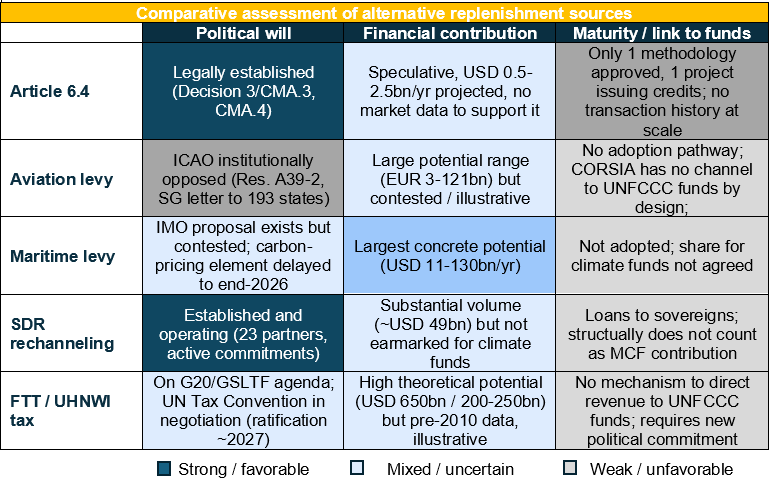
Against this backdrop, innovative sources of funding are becoming increasingly important, in particular the Article 6.4 mechanism, levies on international aviation and maritime transport, the reallocation of Special Drawing Rights (SDRs), as well as taxes on financial transactions (Financial Transaction Tax, FTT) and ultra-high-net-worth individuals (UHNWIs). They differ considerably in terms of their financial potential, political feasibility and stage of implementation (see Table 1).
Table 1: Analysis of alternative replenishment sources
Source: own analysis, Germanwatch and CFAS 2026
The potential revenue from some of these sources is considerable. However, high theoretical revenue does not automatically mean that the funds will actually benefit the MCF. For many of these instruments, there is as yet a lack of political agreement or concrete mechanisms for channelling the revenue. It will therefore be crucial not only to identify new sources of funding, but also to ensure their reliable and transparent channelling to the UN climate funds.
Conclusion: Public climate finance must not be allowed to diminish
The recent analysis by Germanwatch and CFAS makes it clear that the existing resources of the UN climate funds are sufficient to achieve the minimum target of tripling funding by 2030. However, this does not guarantee a sustainable increase in disbursements beyond 2030. Additional and reliable contributions are needed to achieve this.
Innovative financing mechanisms have considerable potential to secure the funding base. However, their political feasibility and concrete links to the climate funds remain unclear in many respects. They must therefore not be seen as a substitute for the industrialised nations’ existing international financing commitments, but must rather complement them.
David Eckstein and Carmen Wabnitz / Germanwatch
Read more: The full publication can be found here.