/ International climate finance / Pledges & Commitments
OECD: Climate Finance reaches record highs
Good news ahead of the Bonn interim negotiations SB64: According to figures now published by the OECD, climate finance for 2023 and 2024 has reached record levels and significantly exceeded the promised annual level of at least $100 billion for the period 2020–2025. Nevertheless, there is criticism and great concern about the future.
The OECD has certainly chosen its timing carefully in presenting its new report on financial support for low-income countries in climate protection and adaptation to climate change shortly before the annual climate talks in Bonn, which are intended to prepare for the next UN Climate Change Conference, COP31. The report examines aggregate climate finance for 2023 and 2024 for the first time.
| Fig. 1: Climate Finance 2022-2024 as reported by the OECD |
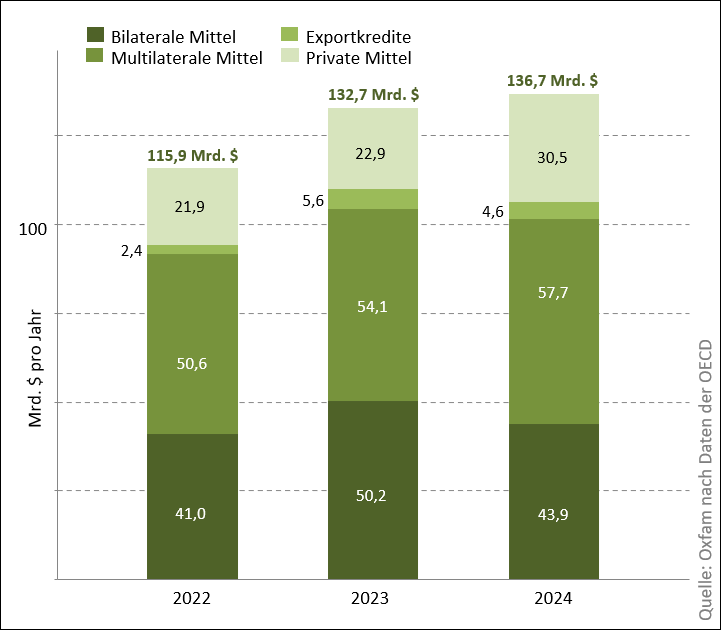
In 2023 and 2024, officially reported climate finance was higher than ever before. However, significant cuts to development aid observed since then in many countries, including Germany, could significantly dim the outlook for the future.
According to the OECD, climate finance rose significantly to €132.8 billion in 2023 and €136.7 billion in 2024, compared with €115.9 billion in 2022. This means that in 2023 and 2024, industrialised countries were well above the level of 100 billion US dollars per year promised for the period 2020–2025, in stark contrast to the situation in 2020 and 2021. In principle, this is good news – even if it describes the past and does not reflect the cuts to development cooperation that have since been made or are planned by many developed countries.
Loans and private investment dominate
Much of the growth compared to 2022 (the most recent reference year so far) was realised, particularly in 2024, through the mobilisation of private finance. Private investments can certainly be used to finance certain measures, such as transforming energy systems in upper income economies, with shifting private investment flows being an essential building block for the global transformation. However, private finance can only be complement public finance, not replace it – at least not where programmes do not generate a financial return, such as measures aimed at adapting to climate change or addressing unavoidable losses and damage caused by climate change.
The problem that the bulk of public support came in the form of loans, which often do not even carry preferential interest rates, remained an issue for 2023 and 2024. This risks further exacerbating the already crushing debt burden of many countries – to tackle a crisis that these countries have often contributed little or nothing to. The issue of debt in climate finance has been a contentious topic at the annual UN Climate Change Conferences for years and is certain to remain so in the future.
Private investment or loans often do little to help the poorest countries. These countries will continue to need public grants to, for example, implement vital programmes for adapting to climate change and to protect people from impending severe weather events or rising sea levels. The increases shown for 2023 and 2024 did not happened for these countries: Climate finance for low-income countries has actually fallen, from €11.1 billion in 2022 to €8.4 billion for 2023 and €9.6 billion for 2024.
| Fig. 2: Climate Finance 2024 by Instrument, Channel and Sector |
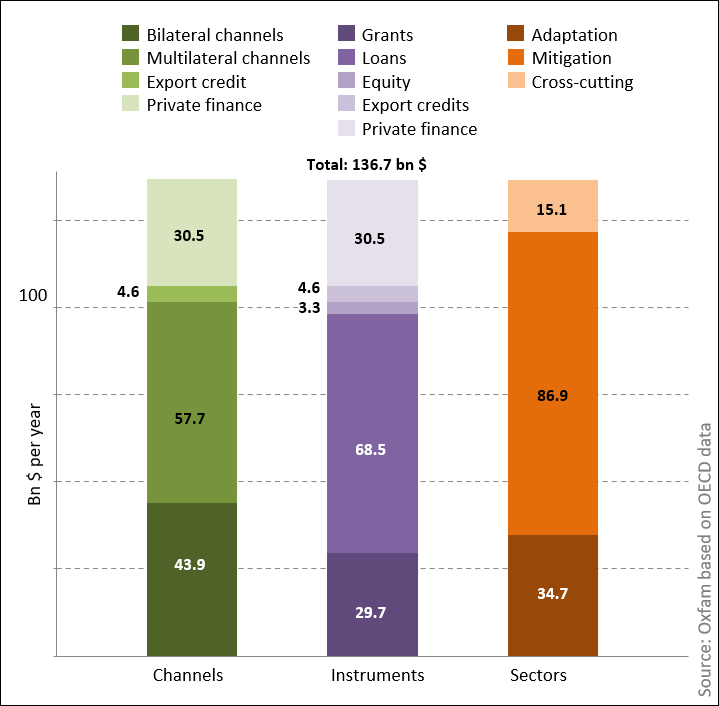
In 2024, as in previous years, a large proportion of climate finance took the form of loans, which often do not even carry preferential interest rates, generate substantial profits for the donor countries and can result in mounting debt for recipient countries.
Adaptation remains neglected
There was a small increase in the area of climate change adaptation – which is crucial for the countries most affected – to safeguard people’s livelihoods for the future, for instance against future droughts or rising sea levels. However, the report confirms that considerable efforts are still needed to achieve the doubling of finance for climate change adaptation by 2025, as promised by developed countries in 2021. Developed countries are thus barely making any headway towards the tripling of annual funding for adaptation by 2035, as agreed at COP30.
Gloomy prospects for the future
The growth in climate finance in 2023 and 2024 must not distract from the fact that there were significant cuts in development cooperation worldwide in 2025, which are set to continue in 2026 and 2027. It is therefore to be expected that climate finance will decline. This would stand in stark contrast to the decisions of the latest UN climate summits, which stipulate, among other things, that support should increase to at least 300 billion US dollars annually by 2035.
And what about Germany?
Germany accounts for a significant share of the nearly 137 billion US dollars now reported for 2024, contributing just under 11 billion euros, of which around 6.1 billion euros came from allocations in the federal budget. However, even in the case of climate finance from Germany, significantly less than half of the funds (around 38 per cent) are provided in the form of grants. There is also a similar imbalance regarding the thematic breakdown between adaptation and mitigation, with 24 and 50 per cent, respectively. (The ratio changes to 37 to 63 per cent if one allocates those measures equally to adaptation and mitigation which, according to the official interpretation, serve both areas and are therefore reported as ‘cross-cutting’.)
Furthermore, the cuts to development cooperation observed in many countries are also taking place in Germany in particular – with consequences for climate finance. The 2026 federal budget could be short of at least one billion euros needed to meet the German government’s pledge to provide at least six billion euros annually for climate finance from the federal budget. For 2027, the government’s further plans for cuts are likely to further cloud the outlook.
Jan Kowalzig, Oxfam