Adaptation / International climate finance / Transparency
Climate Adaptation Finance Index 2026: Adaptation finance is still failing to reach the most vulnerable countries
Who receives support to protect themselves from the climate crisis? And why is it that many of the countries most at risk are being left behind? The Climate Adaptation Finance Index (CAFI) 2026 by Brot für die Welt examines the distribution of international adaptation funding across 129 countries. It reveals a consistent pattern: where high climate risks, poverty and conflicts converge, support is particularly inadequate. At the same time, adaptation funding is now predominantly provided on a loan basis, whilst grants are on the decline. This raises questions about climate justice and the rules governing international climate finance – and about Germany’s responsibility to change them.
More funding does not necessarily mean a fairer distribution
Developed countries pledged the doubling of adaptation funding by 2025 at COP26 in Glasgow in 2021. Yet, CAFI 2026 shows that the trend has fallen short of expectations. Following significant increases between 2019 and 2022, growth of adaptation finance lost momentum in 2023. Whether developed countries have actually achieved the doubling of adaptation funding by 2025 that they pledged cannot yet be conclusively assessed on the basis of the data analysed in the CAFI, but it appears unlikely.
According to the CAFI, 92 of the 129 countries examined are severely or extremely underfunded relative to their climate risks. More than 6.3 billion people live in these countries. Only ten countries fall into the categories of adequate or good funding. The average index value fell slightly from 0.59 to 0.58 compared with the previous year’s edition. There is therefore no sign of a shift towards a more risk-appropriate distribution.
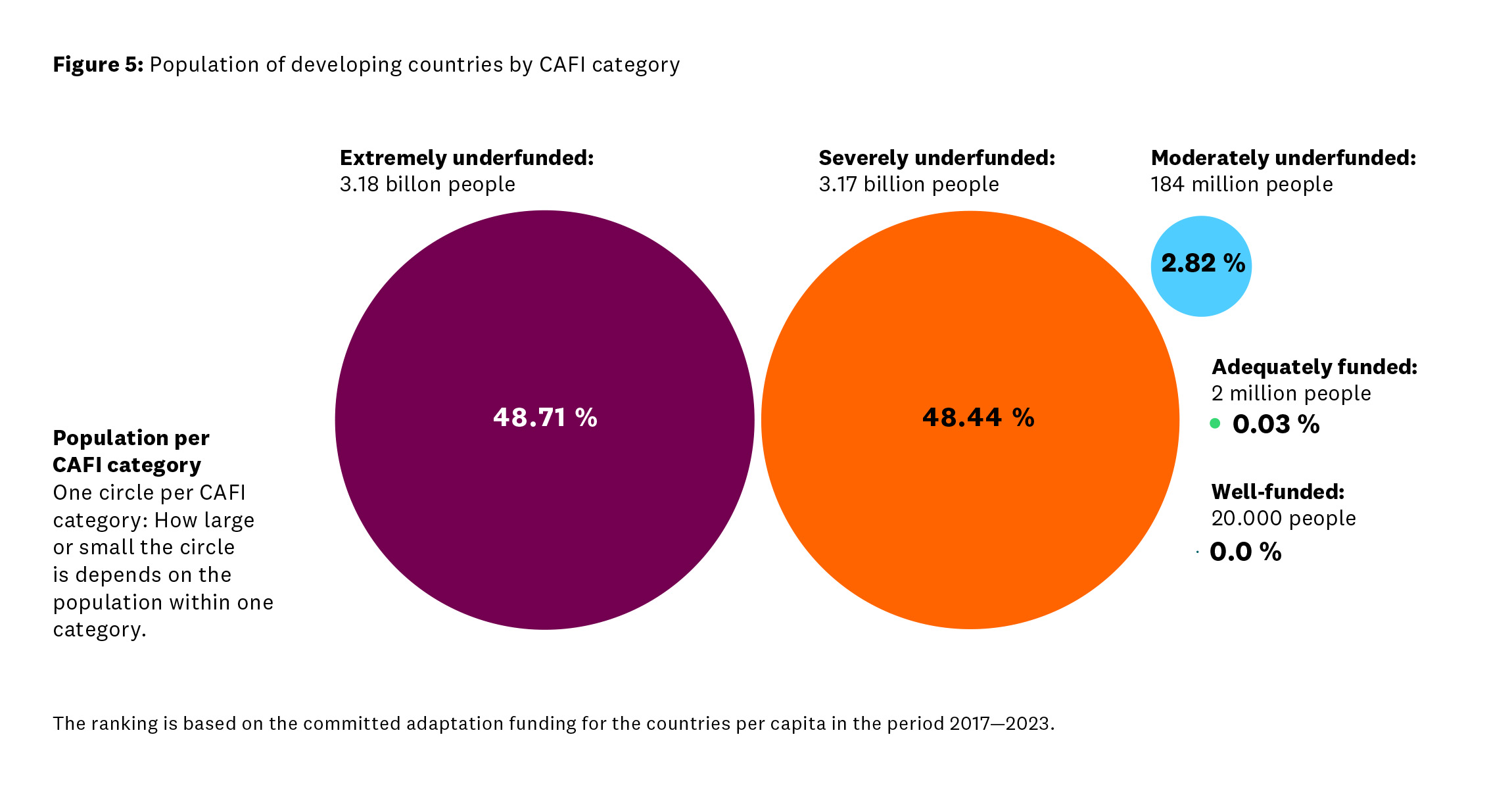
Source: Climate Adaptation Finance Index (CAFI), Brot für die Welt 2026
Structural disadvantage for highly vulnerable countries
Afghanistan, Chad, South Sudan, Somalia, Niger, Mali and Yemen are once again at the bottom of the index. In these countries, high climate risks are compounded by poverty, fragile statehood or violent conflicts, and limited capacity to cope. It is precisely in these places that international support should be a top priority, yet the opposite is the case.
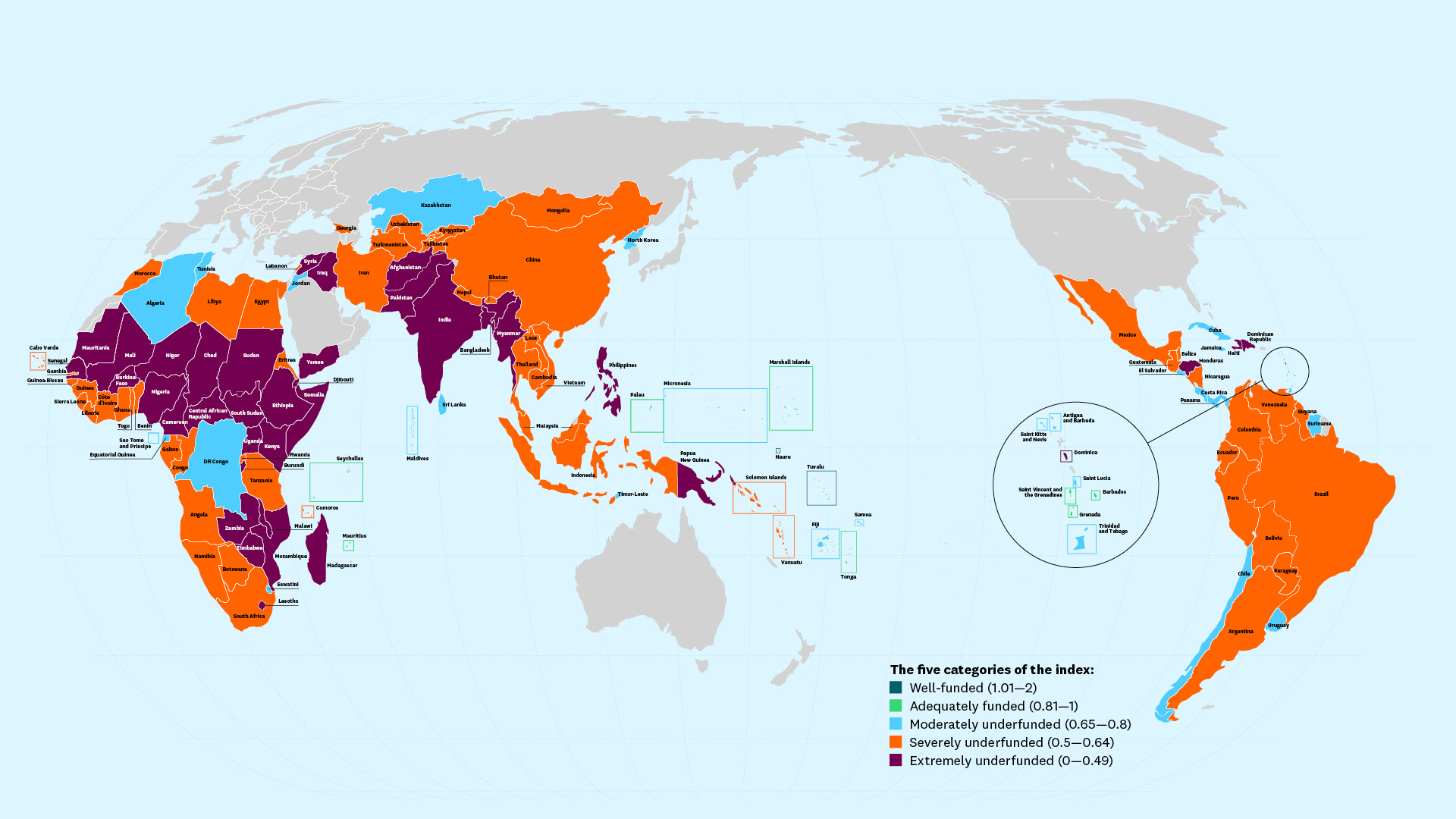
Comparing per capita adaptation funding with country-specific climate risk, CAFI can range on a scale of 0 to 2, the reference value of 1 represents a risk-adjusted distribution of available funds. The fourth edition of CAFI examined funding commitments for the period 2017 to 2023 based on OECD data. This means that the index assesses the distribution of available funds. It does not measure whether these are sufficient to cover a country’s total adaptation needs. Source: Climate Adaptation Finance Index (CAFI), Brot für die Welt 2026
The fact that, across four editions of the index, largely the same countries continue to lag behind points to structural barriers to access. Even if this recurring pattern does not yet provide independent proof that poverty, fragility and high climate risk are the causes of poor access to adaptation funding, the policy implication is nevertheless clear: A financing system must function even where institutions are weak and the conditions for implementation are challenging. Complicated procedures and requirements that fail to take such conditions sufficiently into account can exacerbate existing disadvantages. This demands for dedicated funding windows for fragile and conflict-affected countries, simplified procedures and long-term support for institutional capacity-building.
Small island states demonstrate possibilities – and limitations
Small island developing states (SIDS) fare comparatively well. Tuvalu and Nauru top the rankings. Their position demonstrates that funding which specifically takes vulnerable countries into account is, in principle, possible. Donors can learn from this when it comes to other disadvantaged groups of countries.
However, there is more to the story. Slow-onset climate impacts, such as sea-level rise, are not fully captured by the risk indicators used. Nor does a favourable position in the index indicate whether the actual costs of adaptation are covered. Furthermore, regional averages mask differences: Papua New Guinea, the Solomon Islands and Vanuatu remain underfunded.
Climate adaptation must not lead to further over-indebtedness
For the first time, the CAFI has examined the long-term shift between grants and loans. The proportion of grants in the adaptation funding analysed fell from 57.8 per cent in 2016 to 45.1 per cent in 2023. Whilst grants increased in absolute terms, loans grew at a significantly faster rate.
This is particularly problematic when it comes to adaptation. Coastal protection, early warning systems and the restoration of ecosystems generate significant social benefits. However, they often do not generate direct revenue from which loans could be repaid. Countries with limited financial leeway therefore face a double burden: they must cope with growing climate risks whilst simultaneously servicing additional debt.
What is crucial, therefore, is not only how much funding is pledged, but also on what terms. Particularly poor and climate-vulnerable countries should thus be supported predominantly through grants to strengthen their adaptive capacity.
Loss and damage remain insufficiently visible in statistics
Another key focus concerns funding to address climate-related Loss and Damage. The OECD-DAC Rio markers distinguish between climate mitigation and adaptation, but do not report on Loss and Damage separately. Relevant financial flows may be recorded under other categories without being recognisable as support for addressing Loss and Damage.
The CAFI therefore uses an approximation: it groups the OECD-DAC sectors of food aid, emergency aid, reconstruction and disaster risk reduction together as funding areas relating to Loss and Damage. In 2017, these accounted for 889 million US dollars, and, by 2023, increased to 2.1 billion US dollars. This categorisation makes support visible, but does not provide a complete picture of loss and damage funding.
As climate-related damage increases, this transparency gap becomes more pressing. What is needed is independent reporting that makes overlaps with adaptation, disaster risk reduction, humanitarian aid and reconstruction transparent. Only when combined with robust data on needs can an assessment be made of what funding is lacking.
Germany must fulfil its political leadership role
During the period under review, Germany was the largest bilateral provider of adaptation funding. For the period 2019 to 2023 covered in the report, German funding commitments totalled 28.3 billion US dollars, of which 5.6 billion was pledged for 2023. Germany’s funds are distributed in a slightly more risk-adjusted manner than those of the donor community as a whole. However, Germany’s average CAFI score of 0.61, compared with the international average of 0.58, also shows that it could be significantly strengthen its lead.
Germany’s role as a donor confers a particular political responsibility. The Federal Government should reliably honour its funding commitments and, together with other donors, address structural shortcomings. These include giving greater weight to climate risks, poverty and limited capacity to manage these issues when allocating funds, as well as procedures that are practicable even in fragile contexts.
Germany must drive this agenda forward both bilaterally and within international climate funds and development banks. More grants-based adaptation finance and improved access for local organisations are key starting points in this regard.
The crucial question is: does the funding reach those who need it most urgently? The CAFI 2026 shows just how far the gap between aspiration and reality still is – and where policy changes must begin.
Sabine Minninger / Bread for the World and Thomas Hirsch / Climate & Development Advice
Read more: The full report can be found here.