German climate finance / Pledges & Commitments / Transparency
German climate finance 2025: Decreasing amounts, dominated by loans, broken promises ahead of COP31
German climate finance 2025 decreased by around a billion Euros compared to 2024. The promise to reach at least six billion Euros per year in budgetary allocations by 2025 has not been kept, as a direct consequence of dramatic cuts in official development assistance in the German federal budget. Sobering outlooks ahead of the next UN climate summit COP31.
| Fig. 1: German climate finance 2025 in detail |
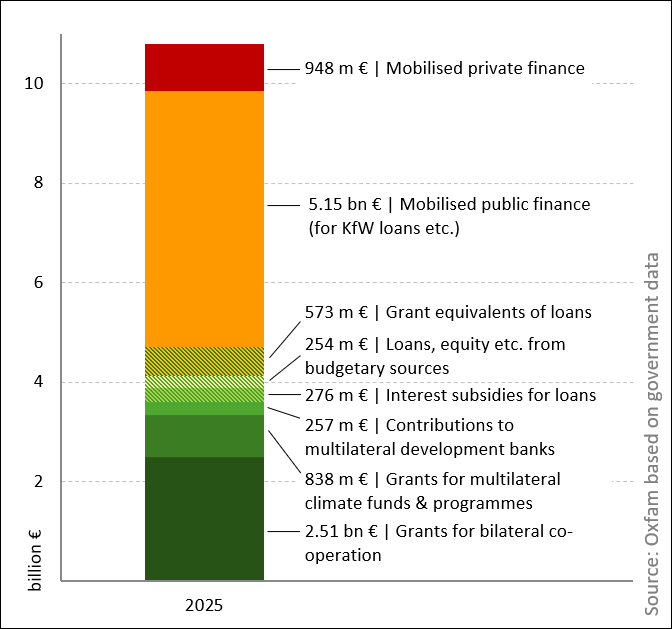
All green-ish areas (filled or hatched) represent finance from budgetary allocations or grant equivalents of loans and are thus part of Germany’s €6-billion-a-year pledge.
According to newly published data by the federal government, German climate finance to support mitigation and adaptation in developing countries stood at 10.8 billion euros in 2025, provided in the form of grants, loans, equity and other instruments as well as mobilised private investments. The total marks a decrease of around one billion euros compared to 2024.
The overall total includes around 4.1 billion euros in budgetary allocations as well as 570 million euros in grant equivalents of concessional loans – far below the promised level of at least six billion euros for these two items (see figure 2 and also below).
A further 5.2 billion euros comprised finance mobilised by the German development bank KfW on the global capital markets in order to put together public loans (that often require no or only very low amounts of budgetary allocations, for instance, to subsidise interest rates) and other instruments. Finally, the government also reports 950 million euros in private investments it claims to have mobilised.
| Fig. 2: German climate finance 2020-2025 and the broken promise 2025 |
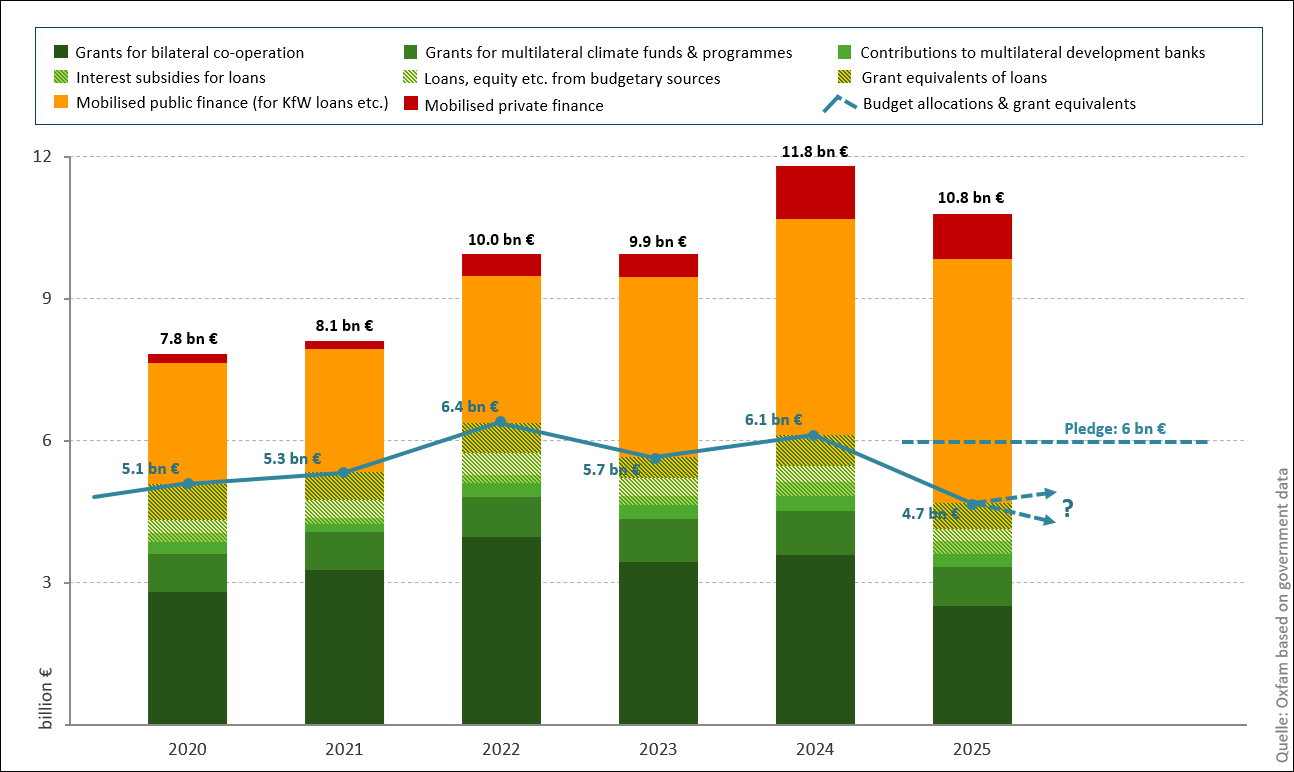
Blue numbers show funds from the federal budget (plus grant equivalents of subsidised loans); black (and bold) numbers show total climate finance (i.e. including mobilised public and private finance). The green or green-shaded areas show various budget items, such as bilateral grants or contributions to multilateral climate funds. The orange areas show funds mobilised by KfW/DEG on the capital market, from which most of Germany’s climate loans are sourced. As per Germany’s pledge, budget allocations for climate finance (plus grant equivalents of climate loans) should have reached at least six billion euros in 2025 but amounted to only 4.7 billion euros. Note that mobilised finance is not part of the commitment.
A broken promise ahead of COP31
Back in 2021, the then German chancellor Angela Merkel had made the pledge to ramp up budget allocations for climate finance (plus grant equivalents of concessional climate loans) to at least six billion Euros a year by 2025 at the latest. The current government coalition has repeatedly confirmed the promise. At last year’s COP30, German chancellor Friedrich Merz assured the world that Germany can be relied upon on climate finance. But while the promised level of six billion Euros was reached in 2022 and also in 2024, in 2025, budget allocations fell 1.3 billion Euros short of the promised level, reaching only 4.7 billion Euros. This comes as no surprise and is a direct consequence of the short-sighted cuts in official development assistance that the federal government plans to expand further over the coming years, putting its internationally acclaimed climate finance promise well beyond reach in 207 and beyond.
The German delegation will have to travel to the UN climate talks COP31 in Antalya with a broken promise in their bags, eroding the carefully crafted basis of trust between developed and developing countries, especially those that have contributed least to the climate crisis but are impact by its consequences first and most. The German government seems to ignore that mutual trust, co-operation and solidarity are the key ingredient for responding to the global climate crisis and the implementation of the Paris Agreement. This includes fulfilling promises made.
Decreasing grants, dominating loans
Not only did 2025 see decreased overall climate finance from Germany but also troubling news on the use of public finance grants. In 2022, grants contributed more than half of total German climate finance, but in 2025, the share has decreased to around a third – a decrease by around a billion euros if compared to 2024.
| Fig. 3: German climate finance 2020-2025 by instrument |
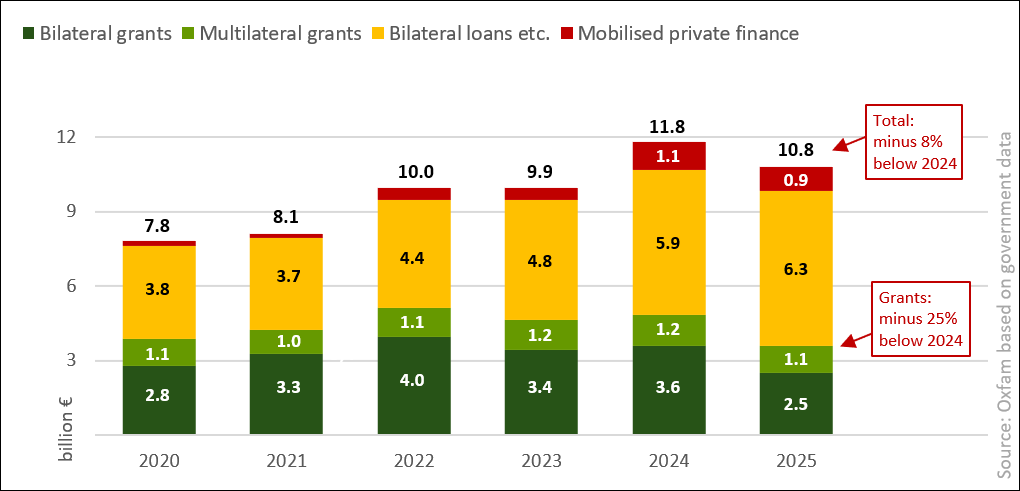
The yellow areas mostly consist of loans but also include a minor part (below 5 per cent) of equity, direct investment and other instruments. Note that in Germany’s official reporting, finance to allow the KfW to subsidy interest rates of climate loans provided to developing countries as well as the grant equivalents of such loans are marked as grants, even though from a recipient countries’ perspective, such finance is not coming in the form of grants but as a component of the loans they receive.
Most of German climate finance comes in the form of loans. Loans can play a role when funded projects result in revenues for the recipient country from which loans can be repaid – in a socially sustainable manner; however, this is not always the case, in particular not for adaptation projects that rarely lead to financial return (compared to a non-climate-change scenario), potentially adding to already heavy debt burdens. Also, recipient countries, many of which have made little or no contribution to the climate crisis, ultimately pay for the financed programmes themselves, when they repay the loans. This makes the use of loans blatantly unjust.
Shifting from grants to loans also leads to a shift in what gets financed. Vital programmes for adaptation and for responding to loss and damage may not materialise, especially in the poorest and most vulnerable countries that depend on grant finance.
| Fig. 4: Adaptation finance 2018-2025 and the elusive doubling |
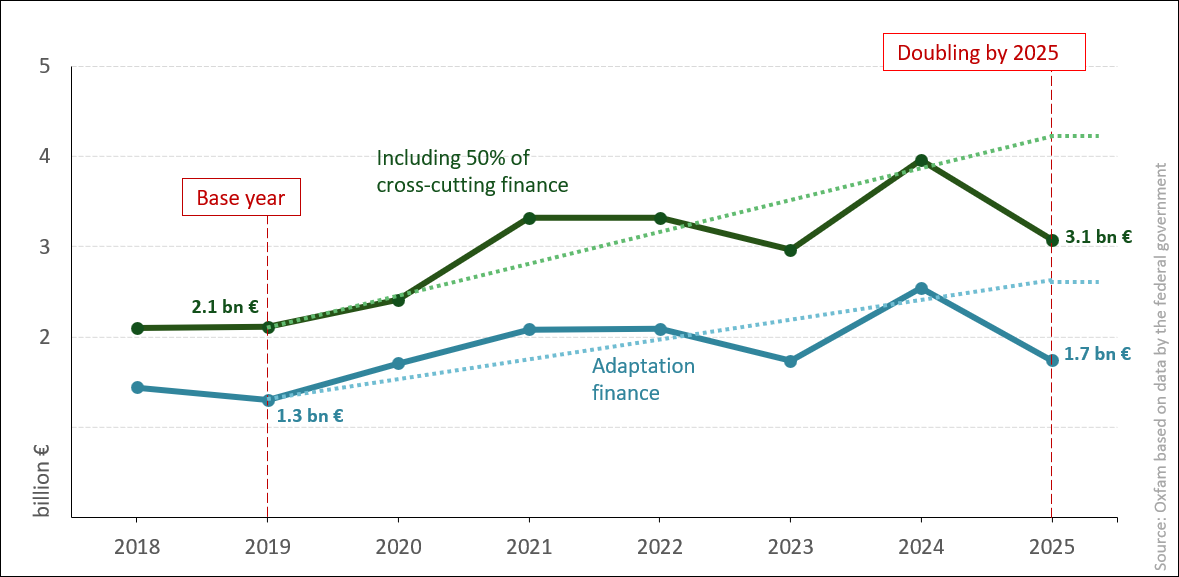
The chart shows German bilateral public climate finance for adaptation over 2018-2025. The blue line shows finance reported specifically for adaptation, while the green line assumes (following the German government’s logic) that 50% of cross-cutting finance to also contribute to adaptation. The dotted lines show a linear path to double Germany’s adaptation finance as a contribution to the global doubling goal adopted by COP26. As can be seen, Germany failed considerably.
Doubling adaptation finance: mission impossible?
In 2021, developing countries agreed to a goal of doubling global climate finance for adaptation by 2025 from 2019 levels. While the goal was framed as a collective goal achieving it has obviously depended on action by individual developed countries. For a few years, Germany was on track, but eventually failed to double its own adaptation finance. 2025 adaptation finance from Germany has fallen back to below 2021 levels. Adaptation finance in 2025 remains, depending on how you count, just between 18 and 31 per cent, far off track the balance between mitigation and adaptation finance provided for in the Paris Agreement.
| Fig. 5: Climate finance 2025 by thematic focus |
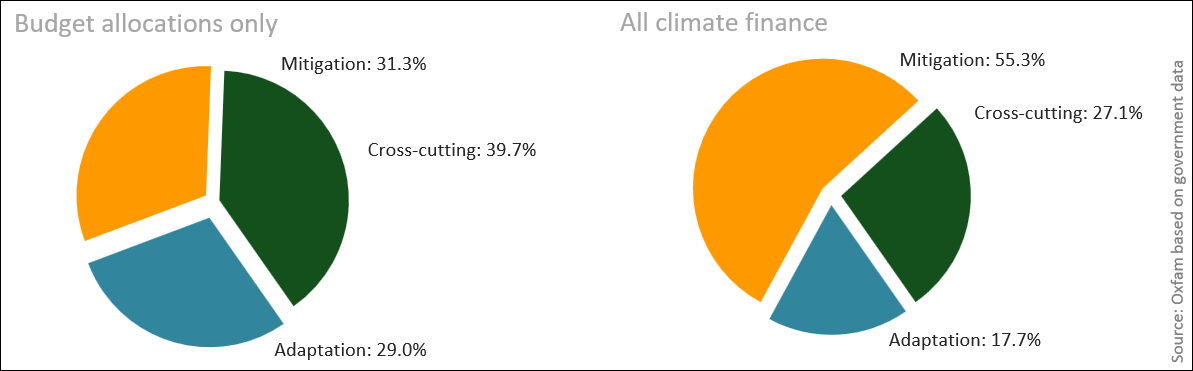
Germany usually argues that it has achieved a balance in the distribution of finance for mitigation and adaptation. However, this refers to budget allocations (plus grant equivalents) only as shown in the left pie chart, also assuming that half of ‘cross-cutting’ finance also contributes to adaptation. When looking at total climate finance (right-hand side), only around 18 per cent specifically aimed at supporting adaptation in 2025.
Next steps for German climate finance
Having broken its six-billion promise should be a wake-up call for the German government and the German parliament. The cuts in development co-operation finance (and the consequences for climate finance) are short-sighted. Climate finance not only funds vital measures in poorer and vulnerable countries to secure people’s livelihoods and protects them against floods, droughts and storms, and not only constitutes a central pillar for the implementation of the Paris Agreement. It also is a key instrument for maintaining global stability in the era of climate change, creates markets for clean technologies and enhances international partnerships in geopolitically challenging times. Climate finance thus serves Germany’s economic and political interests.
The next weeks must be used to cancel the planned additional aid cuts in the 2027 federal budget and to gradually reverse the trend over the next couple of years. There is an abundance of finance available in Germany that the government can tap into. Taxes on extreme wealth, levies on first and business class air travel as well as private jets, as well as taxes on the exorbitant profits of the fossil fuel industry would allow to make rich polluters pay – to contribute to the financing of public goods in general, and climate finance in particular, both in Germany and internationally.
Jan Kowalzig, Oxfam